

Share
Roofing
Tackling the Hidden Thermal Bridge in Standing Seam Warm Roofs
Standing seam metal roofing is frequently chosen for its longevity, low maintenance requirements and distinctive architectural appearance. Yet achieving that performance depends upon the design of the complete roof build-up, including components that will never be visible once installation is complete.
Fundamental considerations are thermal insulation and condensation control.
A traditional ventilated cold-roof construction separates the external metal covering from the insulated area and provides ventilation to help manage moisture. Properly designed, it remains an effective approach, but achieving the necessary ventilation paths, cavity depth and associated detailing can make the roof build-up relatively complex and often deeper than clients or designers would prefer.
Warm-roof construction therefore provides an attractive alternative for many projects, allowing insulation and the external metal roof system to be brought together within a more compact build-up.
This reduction in depth and complexity has some potential pitfalls. Metal is an excellent conductor of heat. Where conventional metal clips and screws penetrate through elements of an insulated roof construction, the fixing assembly can create a localised thermal bridge between the supporting substrate and external metal covering.
Under certain temperature and humidity conditions, thermal bridging at these connections can create localised cold spots and increase the possibility of condensation. The particular concern with a metal roof is that this can occur beneath the metal sheet, where persistent moisture may remain unnoticed.
Addressing the fixing itself was therefore central to the development of the Thermoseam® system from Metal Solutions.
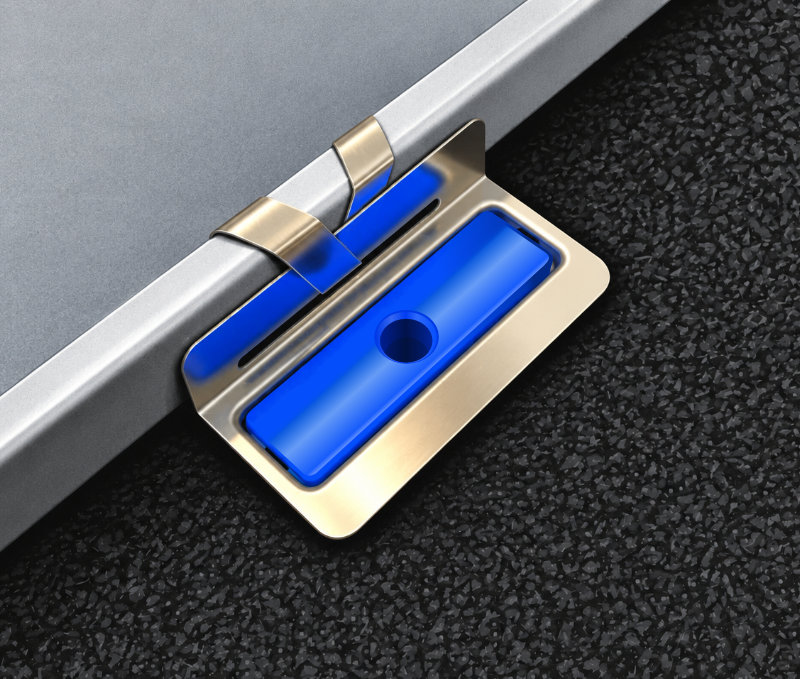
Developed to meet the requirements of warm-roof standing seam construction, Thermoseam® uses a concealed metal roofing clip combined with an insulating polymer sleeve. The mechanical screw fixing passes through this sleeve to connect with the structural substrate below.
This arrangement interrupts the direct metal-to-metal path through the assembly and reduces thermal bridging at the fixing point, while maintaining the mechanical connection required to secure the roof covering.
The principle has been incorporated into several clip configurations and fixing screw depths allowing for a range of material and build up systems.
For traditional standing seam roofing, fixed Thermoseam® clips provide restraint at the appropriate location within the roof system. Sliding versions allow intermediate fixing points to move as long sheets naturally expand and contract in response to temperature changes. This movement is particularly important with architectural metals, where restricting thermal expansion can place unnecessary stress on sheets, seams and fixings. Thermoseam® fixings must be used in conjunction with a breather membrane such as ISO-Mat Pro® or ISO-MAT Metal® and an airtight vapour barrier such as Metal Shield 950 SA ALU.
Metal Solutions has also developed a dedicated Thermoseam® fixing for its Snaplock® roofing system, bringing the same thermally isolated fixing principle to quick fit prefabricated panels.
No single component can replace correct condensation analysis or appropriate roof design, and every build-up must be considered as a complete system. Nevertheless, concealed fixings deserve more attention than their size might suggest.
A standing seam roof may contain hundreds or even thousands of them.
Improving the thermal performance at every fixing point helps ensure long-term performance and demonstrates how some of the smallest components can have a disproportionately important job to do.
For more about Warm Roof Metal Roofing or order Thermoseam® Clips, ISO-Mat Pro®, ISO-MAT Metal® and Metal Shield 950 SA ALU at www.roofing-tools.com.